
The Departure
A short, short fiction

It’s been a long time since I posted fiction. I’ve been much too preoccupied with photography and poetry.
I miss mucking around with words, squeezing them the way we squeezed moist rice in our palms as children and have them ooze out from either end. Be reprimanded by our seniors.
But before the main act, a little update as to what’s been happening.
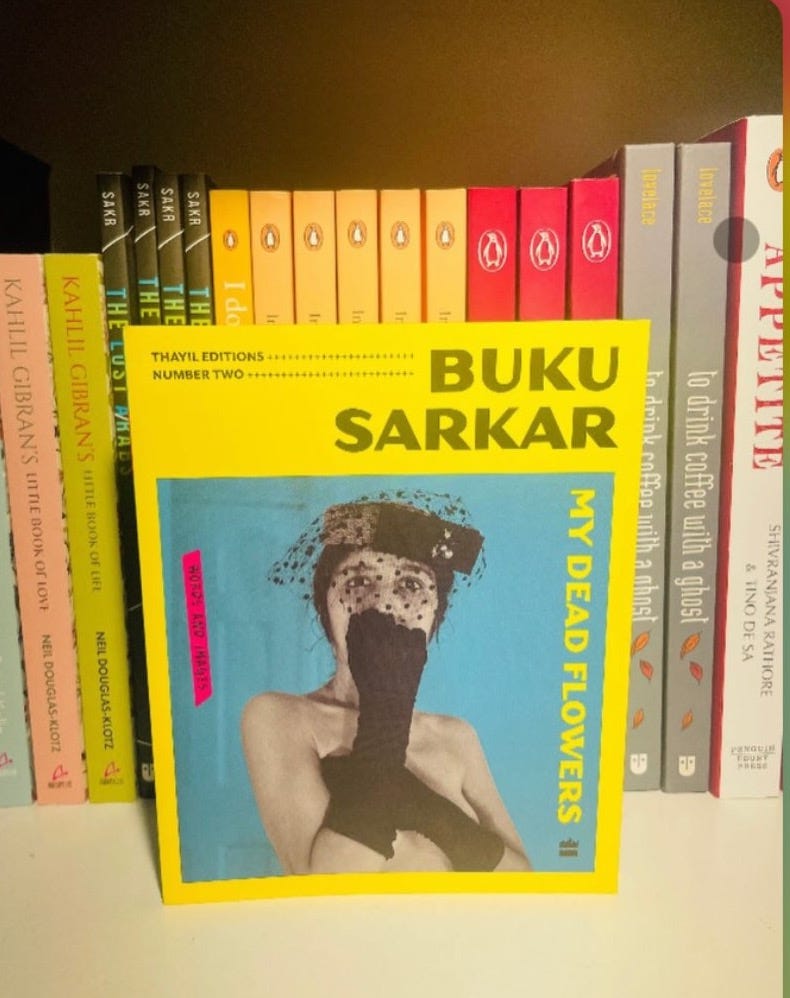
My collection of poems, My Dead Flowers, named after this blog because this is where it all started, is out now. Published by Harper Collins India under a new, lovely imprint—Thayil Editions—which is curated and edited by the lovely Indian writer Jeet Thayil. 20 books in five years, Thayil Editions started with Adil Jussawala as book no. 1. Mine, is number two.
Since Amazon India doesn’t ship internationally, you can find the book through several independent Indian vendors online. Midland Books and a new one I discovered today.
A little about Jeet because he made me believe in myself in a way I never had before , and without him, this book would have never happened. It is also full of images from my self portrait series that no Indian art gallery or establishment will dare touch. (I have been told so in exactly those words. ‘Too much skin.’). Jeet had the balls to get Harper Collins to print them in the book. How? i don’t know…
Jeet is a sublime writer of all genres. Most of you outside India won’t know of him. To give you a bullet point version of his career— he was Booker shortlisted for one of his first novels, Narcopolis. There have been five or six in between and he has just come out with a new book, The Elsewhereans which made me cry from page two.
He was the founder of the Shakti Bhatt Prize, named after his late wife and one of the most important book prizes in India. Sadly he tells me it’s stopped now but the foundation is doing other things.
While the rest of the country fret over Arundhati Roy’s new memoir, they forget Jeet.
Jeet is one of those people who are serious about what they do without taking themselves too seriously. His side gig is being a musician— a role he takes just as seriously and he regularly holds performances, often mixed with his own poetry.
I always felt there are writers and then there are writer’s writers. Perhaps Jeet now belongs to the second category. He is daring, takes risks and this new imprint is really one the western world ought to follow because he’s going to publish what mainstream media never will.
Jeet has also done more for contemporary Indian literature than any living Indian writer. He is also possibly the only contemporary Indian writer, writing in English, I care to read. (We discussed what it means to be an ‘Indian writer’ in our conversation here.).
Second Note:
I’m a little speechless about this one:
I’ve been invited to exhibit along with Marina Abramovic, Ai Wei Wei, Roger Ballen and a few dozen other plebeian artists as myself. The speechless part is that they’ve chosen the very first self portrait I ever took, way back in 2019 when I only had a Leica Q (Leica’s version of a point and shoot camera).
I am a little nervous that I won’t even find my own work in the large space but c’est pa grave. (The French always have words where the English language fails).
If you are in Paris at the end of May, I would love to see you there. The exhibition takes place May 26-28 at the Bastille Design Center, 24 Richard Lenoir Bd. Paris 75011.

Now on to fiction. This is a short one, not to worry. Only a page long.
Remember the Airbnb stories? David, Margaret and Mrs. Patterson? Well here here’s a new one, where David’s wife Margaret finally leaves him while he’s away in Westchester having his weekend rendevouz with Mrs. P.
For more David and Margaret and Airbnb stories, visit here:
The Departure:
I returned from an extended stay in Westchester to find my house emptied of all my wife’s possessions. So that’s why she said she was busy all week.
Yes, I called her when Mrs. P was in the bathroom, reapplying her perfume for the third time that day.
Everything got split 50/50. There’s no way around that, even though everything was mine and earned by me. She got a house and about $3 million. I retained some holdings, my pension, 401k, and about $1 million.
The first thing I notice is the silence—not just the absence of Margaret’s voice, but the absence of her things creating their particular kind of quiet. The Waterford crystal that used to catch morning light through the dining room windows: gone. The Persian rugs that muffled footsteps and gave the hardwood floors their dignity. Even the mahogany dining table where we’d eaten breakfast in careful politeness for fifteen years has vanished, leaving only indentations in the carpet. The scratch marks when we dragged it into the room, when we shifted it around to find its best layout.
Why do these things mean so much to me now? They’re not supposed to. And I know they won’t, in time to come.
In.. Time...To...Come...
I walk through rooms that echo differently now, my footsteps announcing themselves in ways they never did before. Did she take my copy of Thinking, Fast and Slow? I search the empty bookshelf, then remember I’d left it at the hotel in Westchester last Tuesday, after my rendezvous with—but that seems irrelevant now, doesn’t it? The affair that was supposed to liberate me has somehow delivered me into a larger prison.
I conduct a mental inventory with the thoroughness of an insurance adjuster, which is fitting given my profession. The coffee maker: hers, apparently, though I could have sworn I bought it. The good towels: gone. The decent sheets: also gone. What remains are the threadbare items, the backup options, the things we kept meaning to replace. I am left with the matrimonial equivalent of emergency rations.
Did she cut my clothes? I rush to the bedroom closet, seized by sudden paranoia. But no—my suits hang undisturbed, though they look lonely now, spread across a space designed for two wardrobes. She has taken only what belonged to her, which turns out to be everything that made the house feel like a home rather than a collection of rooms.
Freedom, I am learning, is not the absence of constraint but the presence of infinite possibility, which is itself a form of constraint. When Margaret was here, my choices were binary: lie or tell the truth, stay or leave, cereal or eggs for breakfast. Now the possibilities proliferate like cancer cells, each option dividing into further options until the simple act of deciding what to eat becomes a meditation on the nature of choice itself.
What is my responsibility now that there is no Margaret? The question haunts me as I wander through rooms that no longer hold the comfortable boundaries of married life. I was someone’s husband, and that role, however poorly I performed it, gave shape to my days. Now I am simply David, unmodified by relationship, uncontained by expectation, and the enormity of that freedom terrifies me more than any constraint ever did.
I had imagined liberation would feel like expansion, like breathing deeply after years of holding my breath. Instead, it feels like dissolution. Margaret’s presence, even when I was actively deceiving her, provided resistance against which I could define myself. I was the husband who worked late, who had important meetings, who needed space. Now I am simply a man in an empty house, and the distinction between space and emptiness reveals itself to be crucial.
Mrs. P was meant to be supplementary to my life, not foundational. But now, with the foundation removed, I realize how little remains. What am I when I’m not someone’s husband? What stories do I tell about late nights when there’s no one who needs to believe them?
I mean, I know I am someone but I was also Margaret’s husband for over twenty years. And now I must learn to be someone on my own. Who is that? I’m just a nine to five worker with a wife and a mistress and an apartment in the city. But what else am I? These are questions I have to answer now.
Maybe this is why all divorced men take those evening James Joyce classes at the 92Y.
I should feel victorious. After all, isn’t this what I wanted? The freedom to pursue other relationships without the elaborate artistry of deception? But victory, I’m discovering, requires an opponent, and Margaret was never really fighting me. She was simply enduring me, which is perhaps the cruelest form of defeat—to realize you’ve been battling someone who was ambivalent.
The house feels like a stage set after the play has ended, when the actors have gone home and only the props remain. I am both actor and audience now, performing solitude for an empty theater. The irony is not lost on me that in gaining my freedom, I have lost my audience—the very person whose attention gave meaning to my performance of being someone worth deceiving.