

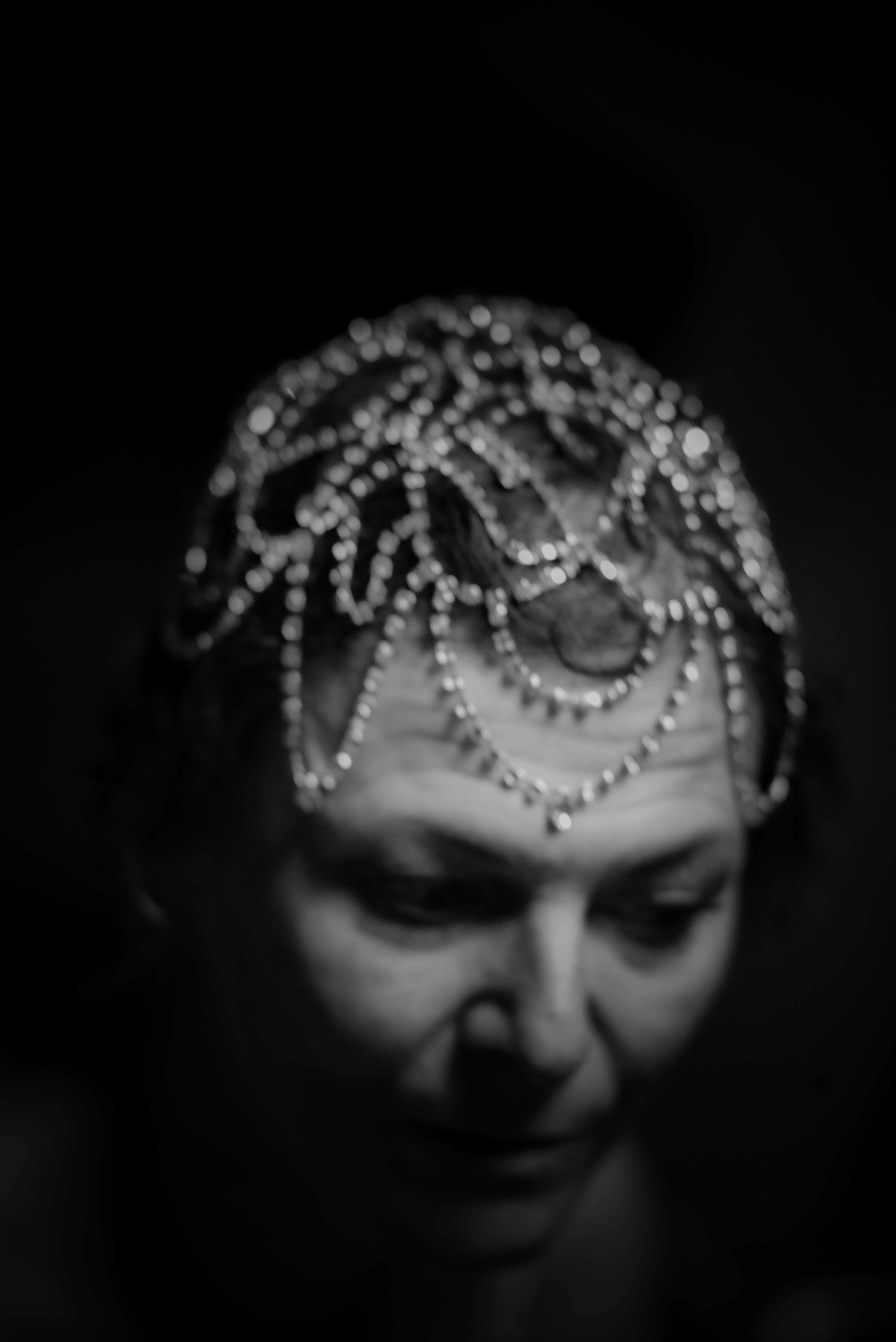
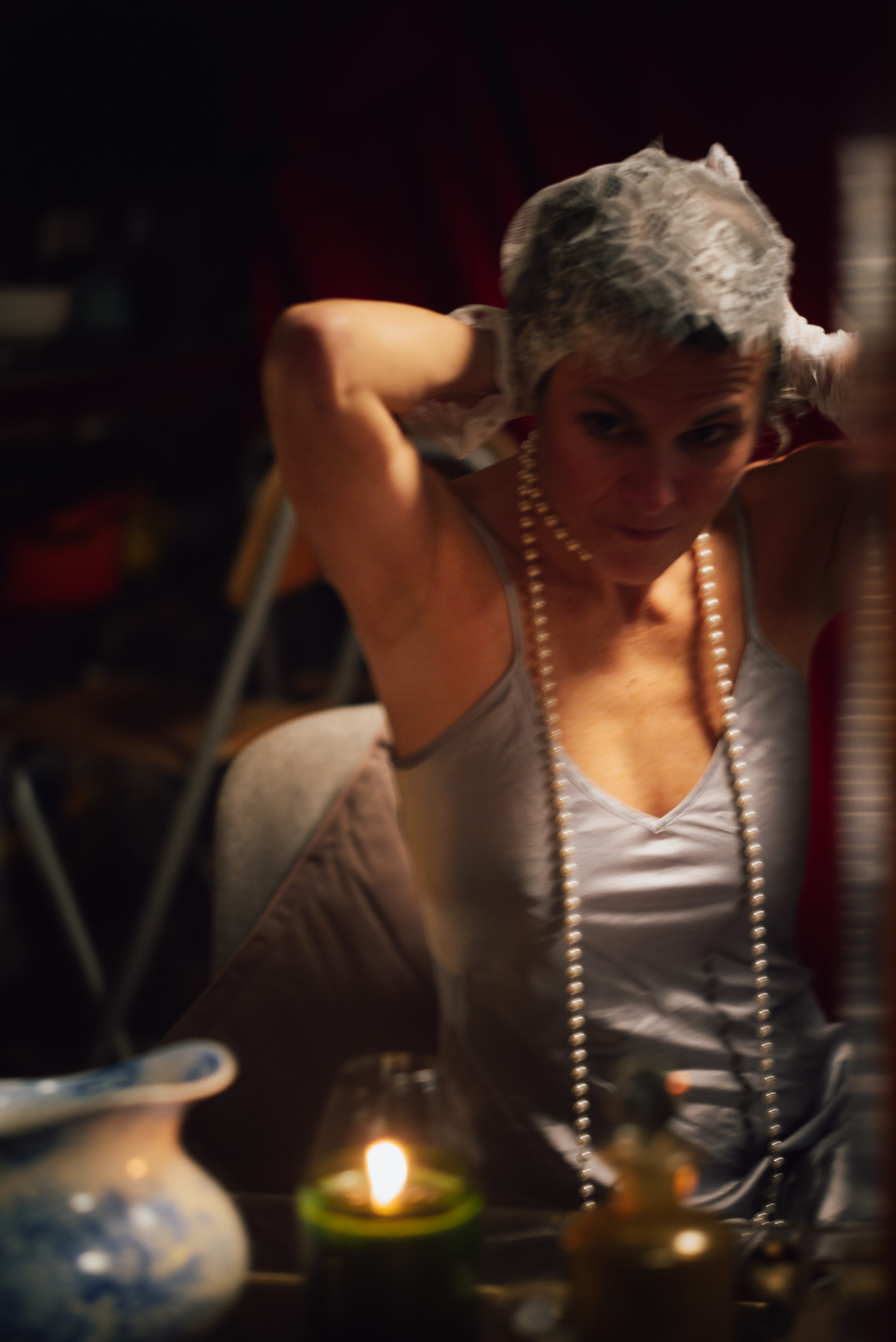
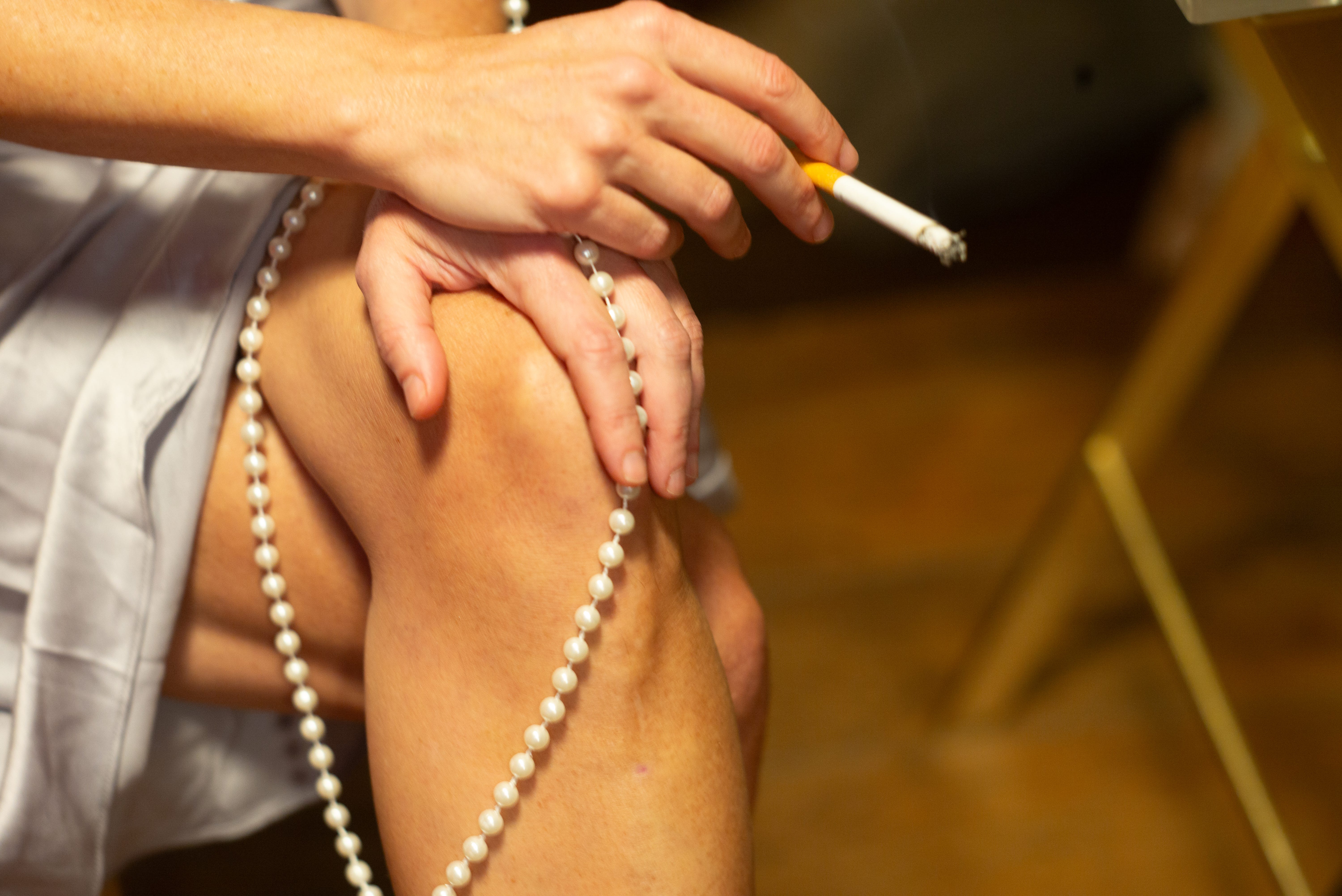
When we photograph a woman dressed as the 1920s in 2024, we do not capture the 1920s. We capture 2024’s desire for the 1920s. This desire is the real subject of the photograph, not the woman, not the era being quoted. The beaded headdress and pearls are not historical documents. They are evidence of how the present feels about the past—nostalgic, acquisitive, unable to let it die.
Barthes wrote about how every photograph says “this has been”—the past tense is built into the medium. But what does the photograph say when it shows something pretending to be from the past? Does it say “this has been” or does it say “this wants to have been”? The photograph traps not time but the fantasy of time, not history but our longing for history to have been different, softer, more beautiful than it was.
There is no timelessness here. Timelessness would mean existing outside of time, untouched by it. But these photographs are deeply marked by time—by at least two different times, in fact. The time being quoted (the 1920s, or our idea of it) and the time of quotation (now, whenever now is, the moment when someone decided to dress as the past). The photographs exist in the gap between these times. They belong to neither. This is not timelessness. This is temporal homelessness.
Sontag understood that photographs are not windows onto reality but constructions of it, arguments about what matters. These photographs argue that the past matters more than the present, or that the past had something the present lacks—permission, perhaps, or a more forgiving visual vocabulary, or simply better light. But in making this argument they reveal something about the present: its poverty, its lack of language for certain kinds of beauty, its need to borrow and quote and dress up in other eras’ clothing.
The woman wears a beaded headdress that might be genuinely old or might be a contemporary designer’s fantasy of old. It does not matter which. Both are equally removed from the actual 1920s. The genuine vintage object is still here, now, in the present, being worn by a woman who did not live through the era it came from. And the contemporary imitation is openly fake, a costume. Either way, we are in the realm of simulation, of signs referring to other signs, of images made from images.
Berger would ask: what social relations are these images hiding? When we photograph a woman in vintage costume, what contemporary reality are we avoiding looking at? Perhaps the reality of aging in a culture that has no use for aging women except as cautionary tales or inspirational exceptions. Perhaps the reality of how beauty has become more, not less, punishing under digital photography’s harsh clarity. Perhaps the reality of economic precarity, of how vintage glamour quotes an era when some women (some women—never all women) had access to leisure, to decoration, to the time and resources necessary for elaborate beauty.
The past being quoted in these photographs is a class fantasy as much as a temporal one. The pearls, the beaded headdress, the cigarette held just so—these signify not just “the past” but “the wealthy past,” a specific stratum of society that had access to such things. When a contemporary woman dresses this way, she is not simply traveling in time. She is traveling in class, trying on the costume of a privilege that may or may not have ever been hers.
But Guibert would insist we look at what is actually in the frame, not what we imagine around it. The soft focus. The downturned face in the first image. The cigarette in the second. The direct gaze in the third. These are real gestures, real choices, made by a real woman in collaboration with a real photographer. The vintage aesthetic is borrowed but the collaboration is present tense. Something is happening here, now, between the woman and the camera. What is it?
Perhaps this: the woman is negotiating how to be visible. She has chosen to be visible through quotation, through borrowed time, because being visible in present time offers her no good options. This is not playful imitation. This is survival strategy. She uses the past’s visual language because the present’s visual language has no place for her.
Is this tragic? Is it liberating? Both, probably. It is tragic that the present cannot photograph her except by pretending to be the past. It is liberating that she has found a way to be photographed at all, on terms she can control, using tools she has chosen. The tragedy and the liberation are inseparable.
Barthes would notice the punctum—the detail that pierces, that breaks through the studied composition to touch us. In these photographs, what is the punctum? Perhaps it is the cigarette, the small ember of realness in the constructed image. Cigarettes still burn. They still consume themselves in present time. The cigarette cannot be vintage even if the gesture of holding it is quoted. It exists now, burning now, marking time in its consumption. This tiny present-tense detail punctures the fantasy of being outside time.
Or perhaps the punctum is in the third photograph, in the gaze that looks back. Everything in the image performs vintage except that look. The look is contemporary. It knows too much. It has seen too many photographs, lived through too many decades of being looked at. That knowledge cannot be hidden by the turban and pearls. It leaks through. It says: I am not really in the 1920s. I am here, now, pretending. And I know you know I am pretending.
This knowledge—this self-consciousness about the performance—is what makes the photographs contemporary even as they quote the past. A genuine 1920s photograph would not know it was a 1920s photograph. It would simply be a photograph, made in the present tense of its own moment. But these images know they are quotations. They are self-conscious about their borrowing. This self-consciousness dates them more surely than any aesthetic detail. They are contemporary photographs pretending to be old, and the pretending is visible, which makes them legible as products of an era that relates to the past through irony, nostalgia, and endless quotation.
Sontag wrote about how photography changed our relationship to the past. Before photography, the past was memory—personal, fallible, fading. After photography, the past became archive—permanent, retrievable, infinitely reproducible. We can see what the past looked like. We have the images. And because we have the images, we can reproduce them, imitate them, dress up as them.
This creates a strange loop. The past is not really past if we can dress up as it, if we can reproduce its aesthetic in new photographs. It becomes a kind of perpetual present—not timelessness but an endless now in which all eras coexist as options, as costumes we can try on. The 1920s are not “over” in any meaningful sense if we can still look like the 1920s, still photograph ourselves with the 1920s’ visual vocabulary.
But this perpetual present is not the same as the actual present. It is a simulated present, a surface without depth. We can wear the 1920s’ clothing but we cannot live the 1920s’ lives. We can imitate the aesthetic but not the social conditions that produced it. The photographs show the costume but hide everything the costume is trying to escape—the actual present moment, with its own anxieties, its own impossibilities, its own reasons for wanting to dress as the past.
Berger taught us to ask: who benefits? Who profits from this nostalgic turn, this endless quotation of vintage aesthetics? Perhaps the fashion industry, which can sell us the same pearls and beaded headdresses our grandmothers wore, repackaged as vintage or vintage-inspired. Perhaps photography itself, which gains authority by quoting its own history, by demonstrating knowledge of photographic conventions. Perhaps the women who use vintage aesthetic strategically, who gain something from the borrowed terms even as they are constrained by them.
But perhaps no one benefits. Perhaps this is simply what happens when a medium becomes old enough to have history—it starts quoting itself, unable to move forward, trapped in the archive of its own past. Photography is over a century old now. It has accumulated enough history that contemporary photographers can spend entire careers sampling it, remixing it, quoting it. This might not be liberation. This might be exhaustion.
Guibert made photographs knowing he was dying. For him, every photograph was charged with urgency—this moment, this body, this light, before it disappears. His images are present tense in a way these vintage imitations can never be. They have stakes. Something is at risk. Time is genuinely passing, not just being performed or quoted.
What is at risk in these photographs of vintage beauty? The woman is aging. That is real. Time is passing for her, marking her, changing her. But the photographs try to stop this, or hide it, or negotiate with it by borrowing an era that had different terms for age, different ways of softening it through blur. The vintage aesthetic is an attempt to protect her from time. But it cannot actually protect her. It can only create an image that seems protected, a surface that seems timeless. Underneath, time continues its work.
This is the sadness in these images. Not the sadness of the woman—she has made her choice and it is a reasonable one. But the sadness of the photographs themselves, which want to trap time, want to create a space outside of temporal flow, and cannot do it. No photograph can do it. The image might persist but the woman continues aging. The aesthetic might quote the 1920s but we remain in the 2020s. Time cannot be trapped. It can only be quoted, imitated, performed. And these performances always fail because time keeps moving even as the image stays still.
Barthes wrote about how photographs are always already past tense—by the time we see them, the moment has died. But he also wrote about how photographs wound us precisely because they show us the living quality of what is already dead. We see her alive in the image, animated, looking at us. But we know (or suspect, or fear) that time has already changed her, that the person in the photograph is not the person who exists now, that every photograph is a memorial to a moment that cannot return.
The vintage aesthetic tries to avoid this wound by making the image intentionally nostalgic, by signaling that it is already past, already memorial. If the photograph announces itself as belonging to “the past” through its aesthetic, then maybe we can avoid the painful recognition that the present is always becoming past, that every moment dies as it is lived.
But this avoidance is also a kind of resignation. It says: we know we cannot stop time. We cannot even photograph the present honestly. So we will photograph the past instead, or photograph the present dressed as the past, and in doing so we will avoid confronting what is actually here, now, alive, changing, impossible to fix or hold.
Where, then, can we find real time in these images?
Not in the beaded headdress, which quotes another era. Not in the pearls, which could be from any decade. Not in the soft focus, which is a contemporary technique imitating a historical one. Not in the cigarette gesture, which is borrowed from old films and photographs. Not in the turban or the light or any of the carefully constructed aesthetic elements.
Real time is in the negotiation. In the space between the woman and the photographer, between the choice to dress vintage and the actual moment of being photographed. Real time is in the collaboration, which happens now, in the present tense, even if it produces an image that tries to escape the present. Real time is in the looking and being looked at, in the three photographs taken in sequence, in the progression from elaborate beaded headdress to simpler turban, from turned-away face to direct gaze.
Real time is in what changes between the images. The first shows her hidden beneath decoration. The second shows her faceless but embodied. The third shows her looking back. Something shifts across this sequence. She becomes more visible, or differently visible, or visibility itself becomes more complicated. This shift is real time—not the fake time of vintage aesthetic but the actual time of a photographic session, of a relationship developing between photographer and subject, of a woman negotiating how much to show and how much to withhold.
Real time is also in the failures. In the cigarette that burns in present tense despite the vintage gesture. In the gaze that knows too much to really be from the 1920s. In the soft focus that does not quite hide the contemporary face beneath it. In all the places where the performance cracks, where the present leaks through, where time refuses to be trapped or quoted or dressed up as something else.
Berger wrote that every image embeds within it a way of seeing. These images embed a way of seeing that is nostalgic, that looks backward, that prefers the past’s visual vocabulary to the present’s. But they also embed a way of seeing that is strategic, tactical, resistant. The woman has refused contemporary terms and borrowed vintage ones. This refusal is visible in the images. It is part of what they show.
So the photographs are both evasion and confrontation. They evade the present by quoting the past. But they confront the present by making this evasion necessary, by revealing that the present has no adequate vocabulary for photographing aging female beauty except by borrowing from other eras. The evasion is the confrontation. The absence is the presence. The fake time reveals the real time by showing how desperate we are to escape it.
Sontag said that photographs are a way of imprisoning reality. But these photographs imprison fantasy—the fantasy that we can escape time by dressing as the past, that vintage aesthetic creates timelessness, that the 1920s can be perpetually accessed through the right props and the right light. The photographs show this fantasy but they also show its impossibility. Time is not trapped. It escapes through every crack in the performance.
Guibert, Berger, Sontag, Barthes—if they were one person, one consciousness looking at these images, what would they see?
They would see a woman negotiating with time using the only tools available: images of other images, borrowed time, performed time, time dressed up as something it is not. They would see photographs that reveal more by what they hide than by what they show—the present hidden beneath the vintage, the aging body hidden beneath pearls, the real time hidden beneath performed time. They would see that all photographs lie but these photographs lie honestly, that their fakeness is their truth, that the costume reveals precisely because it is obviously costume.
They would see that time cannot be trapped in a photograph. It can only be documented in its passing. And the passing is visible here, in the gap between the 1920s being quoted and the 2020s doing the quoting, in the gap between the woman as decoration and the woman who looks back, in the gap between the image that wants to be timeless and the time that continues to mark both the woman and the photograph, making them both mortal, both temporary, both unable to escape the flow they are trying to freeze.
This is what photographs do. They promise immortality and deliver evidence of death. They promise to stop time and prove that time cannot be stopped. They promise to show us the past and show us instead how the present feels about the past—longing, nostalgic, unable to let it go, unable to live in its own moment, always already quoting, always already borrowed, always already too late.
The woman in the beaded headdress is not timeless. She is trapped in time—real time, present time, the time that ages her, that marks her, that necessitates the vintage costume in the first place. The photographs that try to liberate her from this time only document her imprisonment by it. They show that she needs liberation, which means they show that the present is a trap, that time is a burden, that the only escape is performance, costume, quotation, the borrowed time of other images.
There is no real time in these photographs if we mean by “real time” some authentic present moment uncorrupted by quotation. That time does not exist. Not in these photographs. Not in any photographs. Not in the world itself, which we only ever see through accumulated images of the world.
